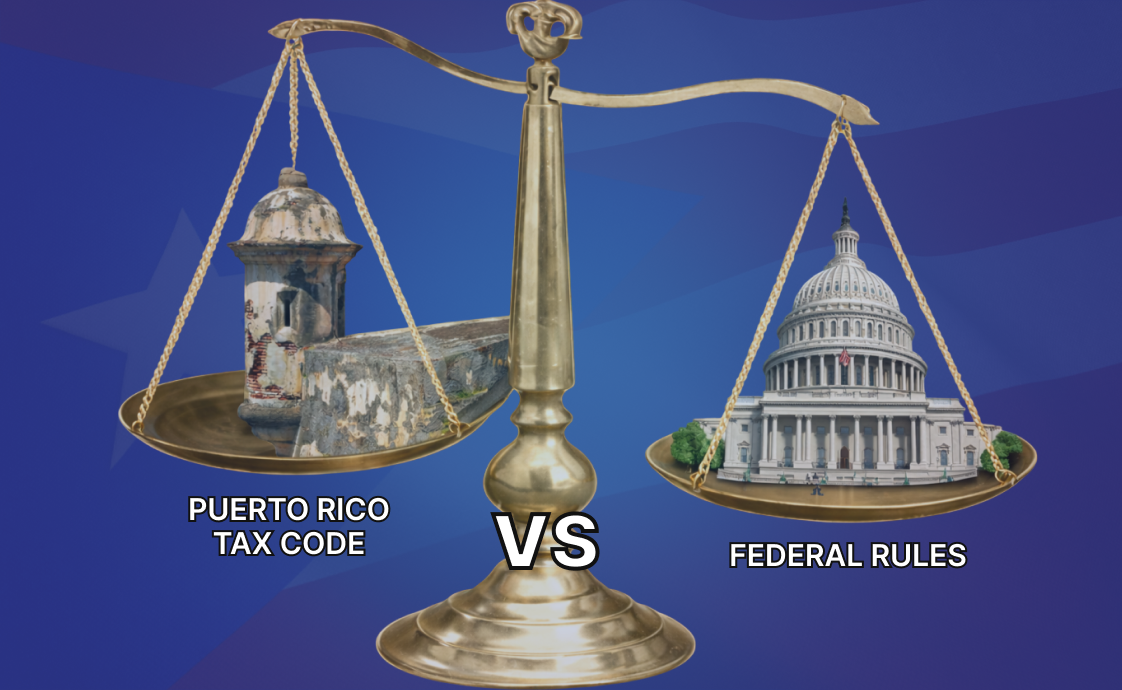
When it comes to Puerto Rico retirement tax planning, especially for business owners, it extends well past just the savings aspect; however, this includes an additional twist that most people don’t discover until after they retire. In order to effectively plan your retirement in Puerto Rico, you will need to adhere to two separate tax systems – Puerto Rico’s as well as those set forth by the United States. If you do not know how to reconcile the two, then you may incur redundant taxation, receive less retirement income, and miss out on opportunities to use your assets over time.
To better understand the interaction of Puerto Rico’s taxation and the federal government when planning for retirement, members of the federal workforce, business owners, corporate employees, as well as the residents of Puerto Rico, must be aware of the impact of taxation on individual retirement accounts (TSP Withdrawals, IRA Distributions, annuity payments and Social Security, rather than federal). Therefore, the tax implications of each retirement account or asset when planning for retirement must consider both the state and the federal tax structure so that you can receive maximum benefit while paying the minimum amount of taxes possible.
Understanding the Two Systems: Tax Code vs Federal Rules
To build a strong retirement strategy in Puerto Rico, you must first understand how these two systems operate on their own and where they overlap. Many residents assume everything retirement-related follows federal rules. However, qualification rules often follow federal law, while taxation usually follows Puerto Rico law. This distinction can significantly impact your retirement income.
Puerto Rico Tax Code: How is Your Retirement Income Taxed?
Puerto Rico residents generally pay income tax to the state, not to the IRS, on income earned within the island. This includes most of your retirement income once you are a citizen already. Puerto Rico’s Internal Revenue Code determines,
- How IRA withdrawals are taxed
- How employer retirement plan distributions are treated
- What percentage may be exempt or subject to preferential tax rates
- How annuity income is taxed
- Local deductions and credits available to retirees
For instance, certain retirement distributions may qualify for special tax treatment under Puerto Rico law if structured properly. However, improper withdrawals or poor planning can result in higher than expected taxation.
This is why your retirement timing and withdrawal strategy matter significantly in Puerto Rico.
Federal Rules: How Your Retirement Accounts Qualify
Even though Puerto Ricans generally do not have federal income taxes on their local income, they are still subject to all federal retirement rules regarding how accounts work.
Federal retirement rules determine:
- Age at which RMDs must begin
- Penalties for early withdrawal
- Amount that can be contributed to IRAs and TSP accounts
- Eligibility requirements for Roth IRA taxation in Puerto Rico
- Eligibility requirements for Social Security benefits
- Medicare enrollment procedures
For federal employees who participate in FERS or TSP, the rules established by the federal government establish how to accumulate benefits and when they may be withdrawn.
Read Also: Retirement or College Funding: How Puerto Ricans Can Plan Both
How This Impacts Common Retirement Accounts in Puerto Rico
Understanding the impact is quite helpful; however, what truly matters is how the theory applies to your actual accounts.
IRA (Traditional and Roth)
Making a Roth vs. Traditional IRA decision may be one of the biggest strategic decisions facing entrepreneurs and corporate executives.
With traditional IRA tax treatment in Puerto Rico, there is the ability to fully deduct the contributions made to the account from gross income at tax time as prescribed by the Internal Revenue Code and federal taxation principles. If you wish to withdraw money from their Traditional IRA account during retirement, it does require payment of applicable taxes at that time, according to the rules and regulations of the Government of Puerto Rico.
Roth Donations made into a Roth IRA Account do not offer any deductions; however, if certain federal requirements are met,t then money withdrawn from an account after retiring may be tax-free.
For individuals earning high incomes in Puerto Rico, selecting between a Roth and a Traditional IRA account is dependent not only on federal income tax planning in Puerto Rico and its brackets, but also on predicting future income taxes attributable to one’s business operations under the laws of Puerto Rico and determining how much income will be available to be taxed upon retirement.
Having a combination of pre-tax and after-tax accounts as your retirement savings will provide flexibility when taking distributions from all of your income sources during retirement; i.e., sale of a business, annuities, real estate, or investment portfolios.”
Employer-Sponsored Plans and Business Structures
To minimize the amount of current income you owe tax on and create wealth as efficiently as possible, business operators utilize their retirement plans in Puerto Rico.
Different options include: corporate plans, retirement plans for self-employed individuals, profit-sharing plans, and defined contribution plans.
These accounts can provide considerable tax-deferred growth, but to achieve that growth properly, they should have a long-term distribution strategy established.
Aggressively accumulating without having a distribution strategy is likely to result in higher income tax in the future. In addition, high-income earners used to generating a lot of cash flows will need to transition from accumulating wealth to generating tax-controlled income during retirement.
Thrift Savings Plan (TSP) for Federal Executives
Federal employees living in Puerto Rico who participate in the TSP operate under federal guidelines for contributions and withdrawals. However, Puerto Rico tax treatment becomes relevant only when distributions begin.
Large TSP balances require careful sequencing. Thus, combining TSP withdrawals with Social Security benefits, pension income, or other income may increase your overall retirement income taxation if you do not structure it properly.
Strategic withdrawal planning can help smooth income across retirement years rather than creating unnecessary spikes.
Tax Deferred Growth and Long-Term Wealth Protection
This is one of the most powerful tools available to high earners. By postponing paying taxes on investment gains, capital compounds more efficiently over time. However, tax deferral does not mean tax elimination. It simply shifts taxation into the future.
For the residents in Puerto Rico, this future taxation will generally fall under local tax rules. The key is determining whether your future tax environment will be more favorable, less, or whether it will just be different.
As a business owner, if you are expecting liquidity events, property sales, or portfolio distributions must align these events with retirement income planning to avoid unnecessary overlap of taxable income. The goal here is not mere growth, but a growth that is coordinated with intelligent distribution.
Withdrawal Strategy: Where Many High Earners Lose Efficiency
It is usually easier to accumulate assets than distribute them properly.
- Retirees may end up doing the following without proper coordination:
- Withdrawing too much from their taxable accounts too early
- Increasing their effective tax rates
- Over-concentrating their holdings in pre-tax accounts
- Ignoring taxes on local sources of income
- Not doing any estate planning
However, the process of structuring an evaluation looks somewhat like,
- The order of the withdrawals from the various types of accounts.
- When to take Social Security benefits.
- How to structure any annuity payments you may want.
- How you should exit your business.
- What you want done with your assets at the time of your death
When an entrepreneur sells their business, they may change their level of income from one year to the next. As such, you should include potential changes in the planning for retirement years in advance of selling your business.
Estate and Legacy Planning Under Puerto Rico Law
What many top income earners want to do is to leave a legacy. Wealth commonly transfers to heirs through both federal estate laws and Puerto Rico tax regulations, which will guide how wealth is passed to heirs. Trust structures, beneficiary designations, and retirement account planning must both meet the legal framework provided by these laws.
Retirement planning is part of the estate plan. For business owners with family assets, coordination can be even more important.
Building a Coordinated Strategy for Puerto Rico High Earners
To build an effective retirement plan when you are a business owner or high-income professional in Puerto Rico, focus on maximizing growth through tax-deferred means during times when you earn the most.
To achieve this, make Strategic Contributions into qualified plans, like a 401(k), so that not only will you have less tax to pay now, but these investments will also grow at a higher rate over time due to compounding interest.
Along with the proper contributions come proper management of your different retirement account types: Traditional vs. Roth IRA. If all of your accounts are pre-tax accounts, you will have more revenue taxed when you retire than you would if you were to have a mix of both account types. A combination of both account types provides for more flexibility and provides you with a higher amount of control over your future tax responsibilities under Puerto Rico’s laws.
A structured withdrawal sequence from your retirement accounts and estate planning will assist in controlling your income and protecting your generational wealth. This entire process must include long-range projections, as you will need to complete more work than just preparing taxes once a year.
Read Also: Guide to Puerto Rican Retirement Planning: 5 Mistakes To Avoid
Final Thoughts
In Puerto Rico, retirement planning requires a dual-system approach. Your retirement accounts are governed by federal regulations, and your retirement income in Puerto Rico is governed by Puerto Rico tax law, which determines how much of your retirement income you actually retain.
When you are a business owner or a high earner, the stakes become greater. In this case, the size of your account balance, the amount of your income, and the complexity of your assets all increase the opportunity and risk you face.
When it comes to Puerto Rico’s dynamic financial system, intelligent planning becomes all about designing a structure that works within both the systems, preserves capital, and, most importantly, offers tax-efficient retirement strategies that support lasting financial independence.