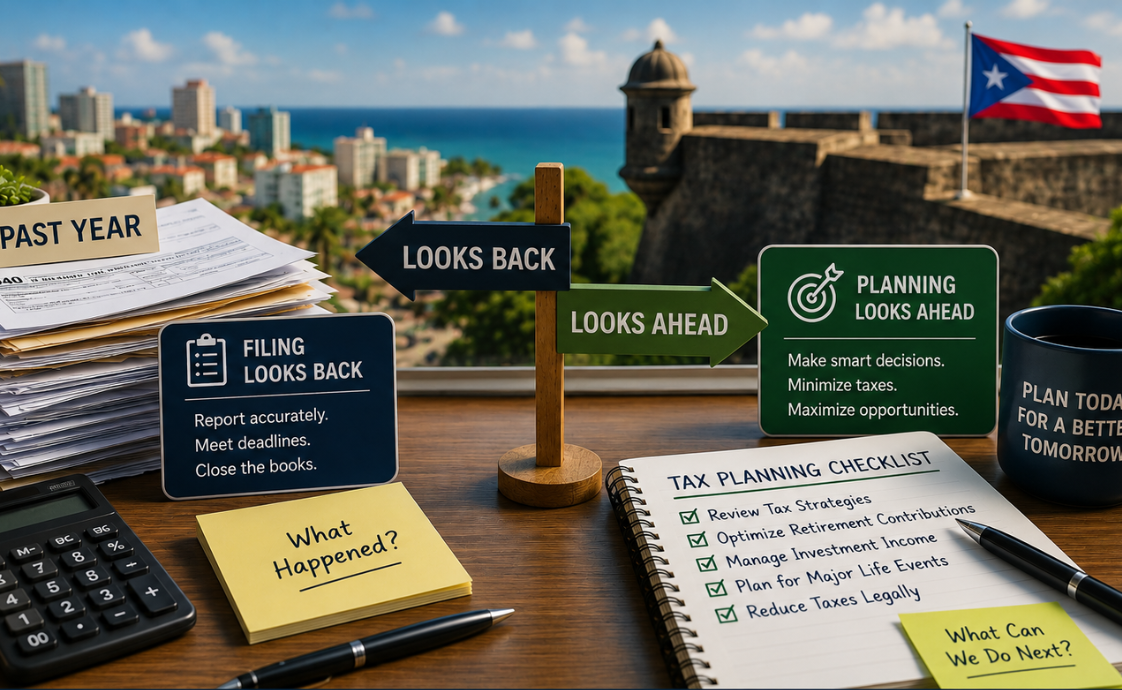
“My accountant handles my taxes, so I’m covered.” It’s one of the most common sentences heard in Puerto Rico financial planning conversations, and it’s also one of the most misleading. In the overwhelming majority of cases, what that accountant is actually doing is tax filing: accurately reporting what already happened last year. What almost never happens in that same relationship is tax planning: proactively shaping what happens this year and next, before the numbers are locked in. These are genuinely different services, requiring different timing, different expertise, and in most cases, a different professional relationship entirely.
Filing Looks Backward. Planning Looks Forward.
The clearest way to separate these two activities is by their relationship to time. Tax filing is fundamentally a backward-looking exercise: gathering last year’s income, deductions, and transactions, then accurately reporting them on a return by the applicable deadline. Tax planning is forward-looking: making decisions during the current year, timing a Roth conversion, structuring a business sale, adjusting retirement contributions, specifically because those decisions still have the power to change the eventual tax outcome. Once December 31st passes, the window for most meaningful tax planning for that year closes. Filing season simply reports whatever happened, or didn’t happen, before that date.
Read Also: Puerto Rico vs U.S. Federal Taxes: What Residents Must File
Why Most Accountants Default to Filing, Not Planning
This isn’t a criticism of accountants; it reflects how the profession’s compensation and workload are structured. Most tax preparation engagements are priced and scheduled around a single event: preparing and submitting the return by the filing deadline. There’s rarely a built-in mechanism, or a built-in fee, for the ongoing, year-round conversations that genuine planning requires. A preparer who sees a client once a year, typically during the busiest weeks of the entire profession’s calendar, simply doesn’t have the structural capacity to also model multi-year strategies for that same client.
Signs You’re Only Getting Filing, Not Planning
A handful of patterns reliably indicate a purely filing-focused relationship, even when the professional involved is highly competent at their actual job:
- The only conversation happens during filing season, with no contact the rest of the year
- Questions are limited to “what happened” rather than “what should we do differently going forward”
- No discussion occurs about decisions still within the client’s control, like retirement contribution timing or entity structure
- The engagement is priced purely per return, with no separate planning relationship or retainer
What Genuine Tax Planning Actually Looks Like
Real tax planning operates on a completely different calendar than filing does, and it touches decisions filing season can no longer influence.
Planning Decisions That Only Work Before Year-End
A short list of common planning moves illustrates just how time-sensitive genuine planning actually is. For 2026, the standard deduction rose to $16,100 for single filers and $32,200 for joint filers, which means a planning conversation about whether to itemize or “bunch” several years of charitable giving into a single year, often through a donor-advised fund, only has value if it happens before the calendar year closes, according to this 2026 tax strategy guide:
- Timing a Roth conversion during a lower-income year, which must happen before December 31 to count for that tax year
- Adjusting retirement plan contributions to capture a deduction against an unusually high-income year while cash flow still allows it
- Harvesting investment losses to offset realized gains, a strategy that has no effect once the calendar year closes
- Structuring the timing of a business sale or major asset disposition around which tax year captures the gain
Why This Distinction Matters Even More in Puerto Rico
Puerto Rico’s dual tax system, involving both Hacienda and, depending on residency status, the IRS, makes the planning-versus-filing gap considerably more expensive to ignore than it would be for a mainland-only taxpayer. Decisions about Act 60 decree timing, income sourcing between Puerto Rico and the mainland, and how retirement contributions interact with both tax systems all require the kind of forward-looking modeling that a filing-only relationship, focused on accurately reporting last year’s numbers, was never designed to provide. Income tax planning that accounts for both jurisdictions simultaneously is genuinely different work than preparing either return in isolation.
The Real Cost of Treating Filing as Planning
The financial cost of this confusion rarely shows up as an obvious, single event. It accumulates quietly, year after year, as opportunities that required action before December 31 simply pass by unaddressed because nobody flagged them until the return was already being prepared the following spring. A missed retirement contribution deadline, an unconsidered Roth conversion opportunity during a genuinely low-income year, an entity structure that made sense five years ago but hasn’t been revisited since, none of these show up as a specific error on a tax return. They show up as money that was never saved in the first place, which is precisely why the gap is so easy to overlook.
How to Tell Which Relationship You Actually Have
A simple test clarifies which category a given professional relationship actually falls into. Ask directly: when was the last time we discussed a decision I still had time to act on before year-end, rather than reviewing what already happened? If the honest answer is “never” or “I can’t remember,” the relationship is almost certainly filing-only, regardless of how skilled or trustworthy the preparer is at their actual job.
Questions Worth Asking Your Current Preparer
A short, direct conversation can clarify the scope of an existing relationship without requiring a complicated evaluation process:
- Do you proactively reach out during the year with planning recommendations, or only during filing season?
- Is there a separate planning engagement available, distinct from return preparation itself?
- Can you walk me through a specific planning strategy you implemented for me last year, beyond accurately filing the return?
A Real-World Example of the Gap in Action
Consider two Puerto Rico small business owners with genuinely identical businesses and identical income. The first works exclusively with a preparer who meets them once a year, in March, to prepare the return based on whatever happened the previous year. The second works with an advisor who reaches out in October specifically to discuss year-end moves: whether an equipment purchase should happen this December or next January, whether a retirement plan contribution should be increased given an unusually strong year, and whether a Roth conversion makes sense given this year’s specific income level. Both business owners’ returns get filed accurately and on time. Only one of them actually had the opportunity to change the outcome before it was locked in, and the difference between these two relationships, repeated year after year, compounds into a genuinely significant gap in long-term wealth.
Why Planning Requires a Different Kind of Relationship
Genuine planning isn’t simply “filing, but with more meetings.” It requires an advisor who understands the client’s full financial picture, not just the tax return in isolation, since a planning recommendation that makes sense from a pure tax perspective can sometimes conflict with a cash flow need, an insurance gap, or a retirement timeline that the tax return alone would never reveal. This is precisely why genuine tax planning tends to happen most effectively as part of a broader financial planning services relationship, rather than as an add-on service tacked onto a traditional tax preparation engagement.
The Timing Problem That Makes This Confusion So Common
Part of why this distinction stays hidden for so long is that the consequences of a filing-only relationship rarely feel urgent in any given year. A return gets filed, a refund or a balance due gets resolved, and the year moves on. Nothing about that process signals that a planning opportunity was missed, because a missed opportunity doesn’t generate an error message or a red flag on the return itself. It simply results in a slightly higher tax bill, or a slightly smaller retirement account balance, than a more proactive relationship would have produced, a gap that’s genuinely invisible unless someone is actively comparing the outcome to what a planning-focused approach would have achieved instead.
Read Also: How to Build a Tax-Efficient Retirement Portfolio in Puerto Rico
Building a Relationship That Covers Both
The strongest financial outcomes come from pairing accurate, timely filing with genuine, proactive planning, not choosing one over the other. A financial planning process in Puerto Rico that explicitly separates these two functions, while making sure both happen and stay coordinated with each other, ensures that planning decisions made mid-year actually get reflected correctly on the return prepared the following spring, rather than the two functions operating in complete isolation from one another.
Making the Shift From Reactive to Proactive
Puerto Rico residents who’ve spent years in a filing-only relationship aren’t necessarily doing anything wrong; they simply may not have realized a meaningfully different service exists. Shifting toward genuine tax planning near me conversations, ones that happen throughout the year rather than exclusively during the weeks before a deadline, transforms taxes from an annual compliance chore into an active tool for building wealth. Comprehensive financial analysis in Puerto Rico that integrates planning alongside filing, rather than treating them as entirely separate projects, is where the real, compounding financial value actually gets captured.