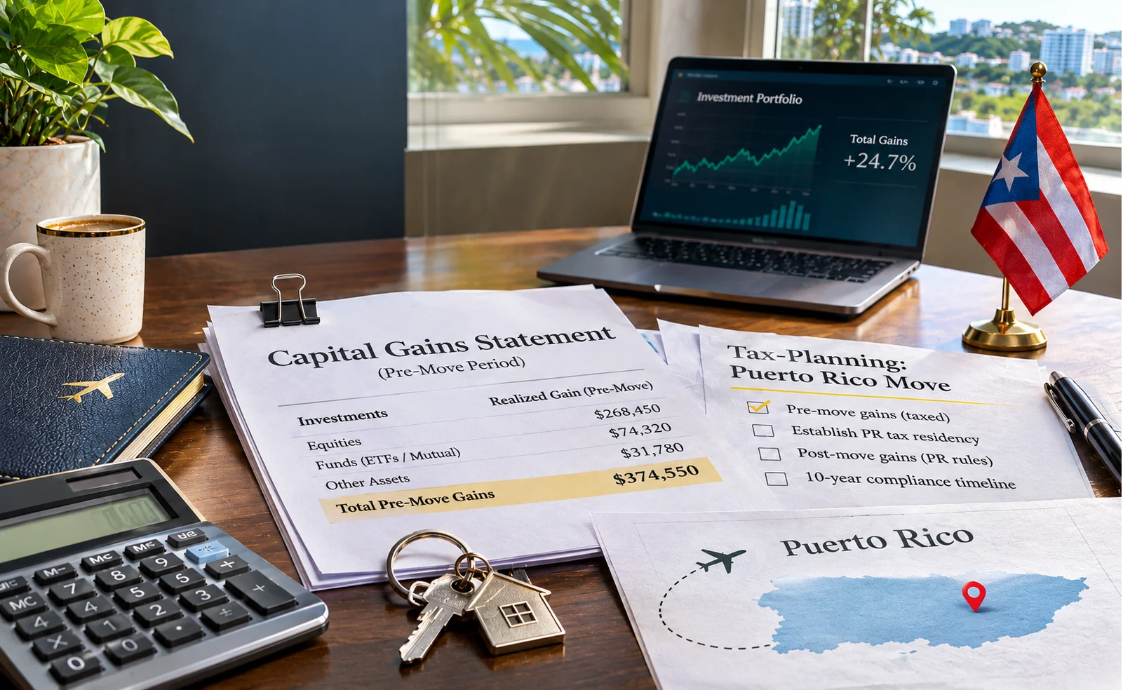
Picture a business owner who spends two years planning a move to Puerto Rico. The portfolio is large, the stock position has tripled, and a friend has said that everything sells tax-free once you are a resident. Eighteen months after arriving, the owner sells, and the tax bill is far larger than expected. The surprise was not a loophole being closed. It was a rule that was always there and rarely explained: gains that built up before you moved are not treated like gains that build up afterward.
That rule has a clock attached. For federal purposes, the clock runs 10 years. On the Puerto Rico side, Act 38-2026 ties a reduced 5% rate to the same ten-year mark. Both matter if you are planning to sell a business, a stock position, crypto or a rental property after relocating, and both depend on records you can only build at the moment you move.
This guide explains the idea in plain and simple language: how the move date divides your gains, what the 10-year rule does on each side of the tax system, what a realistic example looks like, what changed in 2026 for new applicants, and which mistakes cost movers the most. It is educational, not tax or legal advice, and every figure in the examples is hypothetical.
Why the Move Date Splits Your Gains in Two
Most of the confusion about Puerto Rico and capital gains comes from treating a gain as one number. In practice, a gain on an asset you already owned when you moved has two parts, and the tax system looks at each part separately.
The Basic Idea: Before and After Residency
Think of an asset as having a timeline. From the day you bought it until the day you became a bona fide Puerto Rico resident, any growth is pre-move appreciation. From that day until you sell, growth is post-move appreciation. Puerto Rico’s investor incentive under Act 60 is aimed at the second part: gains that accrue after you establish residency.
The first part is the one that surprises people. Appreciation that happened while you lived on the mainland earned its connection to the United States when it happened, and the rules for sourcing income reflect that. A decree can shape how Puerto Rico taxes you, but it does not rewrite where the income came from for federal purposes.
Why Your Valuation on Move Day Matters
Because the gain is divided at the move date, the value of the asset on that date becomes the most important number in the whole calculation. If you can prove it, you can show how much of the final gain is post-move. If you cannot, you are leaving the division to a conversation with a tax authority years later.
Treat the move date as a deadline for building documentation. A short checklist helps:
- Brokerage statements showing share counts and prices at or near the residency date.
- A written appraisal for a private business, real estate or art, dated close to the move.
- Records of your original purchase price and purchase date.
- Proof of the date you became a bona fide resident, such as your lease or deed, your presence records and your first Puerto Rico return.
Read Also: $11,000 or $15,000: Puerto Rico’s Pension Exclusion Explained
The 10-Year Clock, Explained
The phrase “10-year rule” is used loosely, and that causes mistakes. There are two separate ten-year ideas, one federal and one in Puerto Rico’s incentive law, and they work differently.
The Federal Side: The Section 937 Lookback
For federal purposes, the question is whether the gain is treated as Puerto Rico-source income, which bona fide residents can exclude under Section 933, or as United States-source income, which stays taxable. Treasury regulations under Section 937 contain a ten-year lookback: gain on property you held before becoming a resident is generally not treated as Puerto Rico-source income if you sell it within 10 years of the move, to the extent it reflects pre-move appreciation.
A March 2026 summary of Act 38-2026 from Riefkohl Law describes the same federal lookback and adds a practical point: taxpayers may be able to split a gain between pre-move and post-move portions using the possession holding period method. In plain terms, the regulations offer more than one way to divide a gain, and the method you choose can change the result. That choice deserves a preparer’s attention before you sell, not after.
The Puerto Rico Side: 5% After 10 Years
The Puerto Rico rule is separate. Under Act 38-2026, as described in a March 2026 DLA Piper summary, capital gains recognized ten or more years after you became a Puerto Rico resident are taxed at 5% on the portion that accrued before residency. For decree holders who applied by the December 31, 2026 deadline, that treatment runs through 2035. For later applicants, the program runs through 2055.
Notice what this does and does not say. It sets a reduced Puerto Rico rate for patient holders. It does not say pre-move gains are exempt, and it does not change the federal analysis, which has its own ten-year test.
What Happens If You Sell Earlier
If you sell inside the first ten years, you do not get the 5% treatment on the pre-move part, and the federal lookback generally treats that part as United States-source. The post-move part may still qualify for the decree benefit. The result is that early sales tend to produce the highest tax on exactly the portion people assumed was safe.
That does not make an early sale wrong. Sometimes a business is sold, a partner is bought out or a family needs liquidity, and the timing is not your choice. It means the sale should be modeled in advance so the number is no surprise.
A Worked Example With Numbers
Examples make the split easier to see. The one below is hypothetical, simplified and for illustration only. It ignores state taxes, net investment income tax, fees and anything specific to your decree.
Maya’s Stock Position
Maya bought shares for $100,000 several years ago. On the day she becomes a Puerto Rico resident, the position is worth $400,000, which she documents with statements and a dated valuation. Later she sells for $700,000. The total gain is $600,000, and it divides cleanly: $300,000 accrued before the move and $300,000 after.
The $300,000 of post-move growth is the part a decree is designed to address. The $300,000 of pre-move growth is the part the ten-year rules address.
Three Possible Sale Dates
Consider what changes when Maya sells at different points. The numbers show the shape of the issue, not a tax calculation you can rely on.
- Sale in year three. The pre-move $300,000 is generally treated as United States-source and may face federal capital gains tax at rates of up to 20%, which would be as much as $60,000 before other taxes. The post-move $300,000 may qualify for the decree exemption.
- Sale in year eleven. Puerto Rico’s reduced rate on the pre-move portion would be 5%, or $15,000. The federal result needs a preparer’s confirmation because it depends on sourcing and how the gain is divided.
- No sale at all. Maya pays nothing on the gain while she holds. A buy-and-hold investor with other income to live on has the most flexibility, and patience is the planning tool that costs nothing.
The lesson is not that one date is right. It is that the same asset can produce very different results depending on when it is sold, and you can only compare them if you did the paperwork on the move date.
What the Example Leaves Out
Real situations add layers that the example skips. A business sale may include goodwill, a non-compete payment and installment terms, each sourced differently. Crypto and private company shares can be hard to value on a given date. Rental property can carry depreciation recapture. Dividends and interest follow their own decree rules, and a spouse’s separate assets can change the picture.
For that reason, treat the example as a way to learn the vocabulary, not as a forecast. Your own numbers should be run by a professional who has your records in front of them.
What Changed in 2026 for New Movers
Timing is unusually important this year, because the rules for new applicants changed and a filing line is close. If you are still deciding, this section is the one to read twice.
The December 31, 2026 Filing Line
Act 38-2026 keeps the 0% rate on dividends, interest and post-residency capital gains for individual resident investors whose applications are filed by December 31, 2026. Applications filed after that date face a 4% rate on the same categories, through 2055. Existing decree holders are generally grandfathered and may elect to adopt the new terms. JLA has also covered the change in its Act 38-2026 deadline article.
A filing deadline is not a reason to move. Residency is a real life change with real tax consequences, and a decree does not substitute for meeting the residency tests. If you have not already decided to relocate for reasons beyond taxes, a deadline should not make the decision for you.
New Conditions for Applicants After 2026
For applications filed after December 31, 2026, the law adds a six-year look-back: applicants must not have been Puerto Rico residents during the six years before moving. Applicants also generally have to hold title to a principal residence and keep to the program’s annual obligations, including a $10,000 charitable donation and a compliance report fee.
The statute also leaves room for implementation details, and early commentary noted that some approvals were still being finalized. Confirm the current rules with DDEC and counsel before you file.
Who Should Slow Down Before Filing
A few groups benefit from extra care before they apply. People with a pending large sale should model it first, because filing a decree application does not change what they already own. People with a mainland business still operating should confirm how much of their time and income will really move. Families with children in school, aging parents or a mainland home they intend to keep should weigh how those ties fit the residency tests.
None of this argues against moving. It argues for deciding with a full picture, so the tax benefit supports a plan you would choose anyway.
Mistakes That Cost Movers the Most
Most expensive mistakes are not exotic. They are small gaps in records or assumptions that turn into large differences once a sale closes.
Common Mistakes
Review this list before you sign a sale agreement.
- Skipping the move-day valuation and trying to reconstruct it years later.
- Selling in the first few years without modeling the pre-move portion.
- Assuming a decree changes federal tax treatment on its own.
- Moving assets into an entity shortly before a sale and expecting a fresh starting point.
- Leaving residency unclear, with a mainland home, extended stays or family ties that point elsewhere.
- Forgetting that the mainland state you left may have its own rules on its residents’ gains.
The IRS Is Paying Attention
Federal authorities have signaled that they look closely at sourcing claims, especially for large sales of crypto, stock and business interests shortly after a move. Informal IRS guidance in 2024 addressed attempts to treat United States-source gains as Puerto Rico-source by routing them through entities.
This is not a reason for alarm, but it is a reason for clean records. Contemporaneous documents carry far more weight than explanations created later.
Read Also: Act 60 Chapter 2: The 4% Rate for Puerto Rico Physicians
How to Plan Before You Move
Planning a move with large unrealized gains is a coordination problem, because tax, investments and your life plan all depend on the same dates. A good process is simple and sequential.
Questions to Ask Before You Sell
Bring these to your advisors. A strong income tax planning in Puerto Rico engagement starts by asking what you own, when you bought it, and what it was worth on move day. A financial investment advisor in Puerto Rico can then help you decide whether selling is the right investment move at all, because tax is only one input.
Also ask how each asset is held. Stock in your own name, an interest in a partnership and shares of a closely held company can raise different sourcing questions, and your advisors should address each one separately.
Building the Timeline
A financial planning process in Puerto Rico that works backward from your goals usually looks like this:
- List every appreciated asset, its cost, purchase date and estimated value.
- Decide which assets you plan to hold, which you may need to sell and which you could gift or restructure.
- Mark the date you expect to become a bona fide resident, then count forward ten years.
- Build a cash plan so you are not forced to sell early to cover living costs.
- Review the plan each year as laws, values and your life change.
A comprehensive financial analysis in Puerto Rico puts these pieces on one page: your assets, your cash needs, your timeline and the tax result of each sale date. That page is what lets you sell on purpose instead of by accident.
Keep the plan flexible. Asset values move, laws are amended and personal circumstances change, so the best timeline is one you revisit at least once a year with your advisors rather than one you set once and forget.
Finally, protect what you build. Consider asset protection planning in Puerto Rico with an attorney, especially if a business sale will make you more visible to creditors or claimants.
Conclusion
The 10-year rule is really two rules. Federally, gain on property you owned before moving is generally not treated as Puerto Rico-source if you sell within 10 years. Under Puerto Rico’s incentive law, as amended by Act 38-2026, the pre-move portion of gains recognized after ten years can be taxed at 5%. Neither rule makes pre-move gains disappear, and both reward people who documented their starting values.
If you are weighing a move, the useful questions are practical ones. What do you own, what was it worth on the day you became a resident, how long can you hold it, and what happens in each year you might sell? The answers shape not only taxes but also how much risk you take and when.
Disclaimer: This article is for educational purposes only and is not individualized tax, legal, insurance, investment or financial advice. Tax laws and incentive programs change, examples are hypothetical, and no tax outcome is guaranteed. Confirm your situation with the Puerto Rico Department of Economic Development and Commerce (DDEC) and with your own licensed tax and legal professionals before acting.