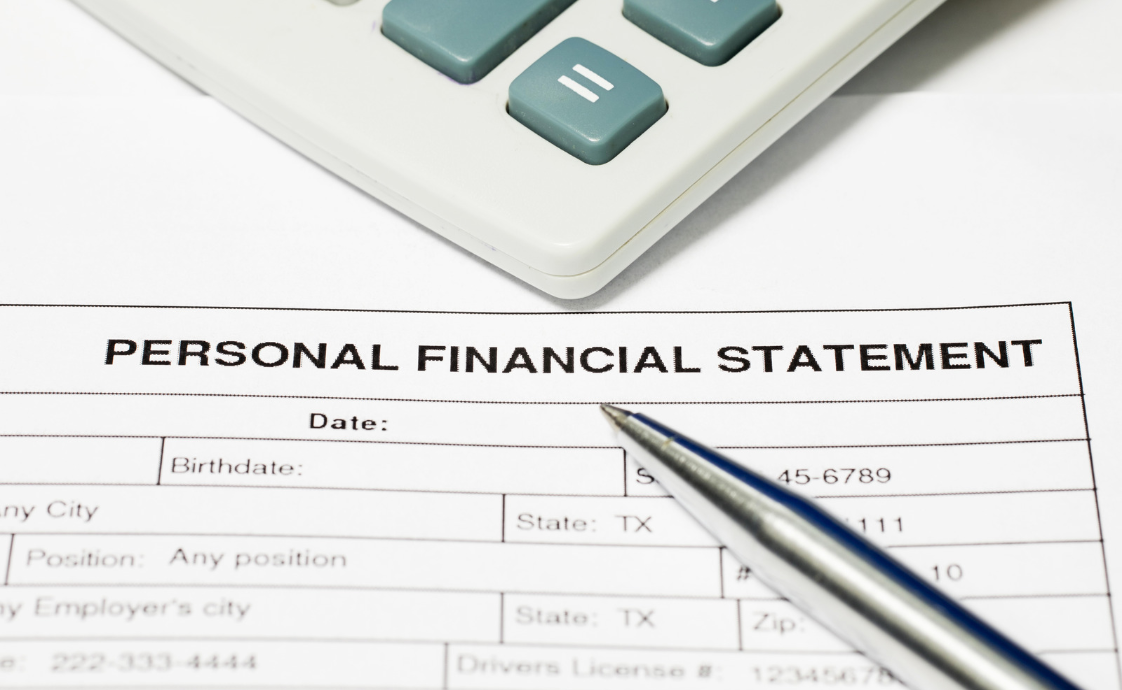
It is Thursday afternoon, and an email arrives from your banker: “To move your loan forward, we need your personal financial statement, signed and dated within the last 120 days.” You built the business, you know the revenue to the dollar, and you have never once written down what you personally own and owe on a single page. Most owners in Puerto Rico have not, because the business has always been the thing that needed the attention.
That page matters more than most owners expect. For many business loans, the lender is not only judging the company. It is judging you, because you are likely to be asked to stand behind the debt personally. The statement is how a banker sees your assets, your debts and the promises you have already made, all at once, and a clean one can shorten an approval while a messy one can stall it for weeks.
This guide walks through the form the way a banker reads it: who has to complete it, what each section really asks, the Puerto Rico details that general guides skip, a worked example with numbers, and a weekend plan to prepare it without panic. It is educational, the figures are hypothetical, and your lender’s exact requirements can differ from what is described here, so treat your banker’s checklist as the final word.
Read Also: Can PR Business Owners Claim the 20% QBI Deduction?
Why the Bank Wants Your Personal Numbers
Before filling in a single line, it helps to understand why a business loan turns into a personal conversation. Once you see the logic, the form stops feeling like an interrogation and starts feeling like a map the lender needs in order to say yes.
The Business Is Only Half the Picture
A small company rarely has enough history or hard assets to carry a loan alone. Lenders know that an owner’s personal strength, meaning savings, property, other income and existing debts, often decides whether a loan gets repaid when a slow quarter hits. The personal financial statement turns that strength into numbers they can compare across applicants.
It also works in the other direction. A bank wants to know whether the loan you are asking for, combined with everything you already owe, would leave you stretched. A statement that shows healthy liquidity and modest personal debt supports your application. One that reveals three cosigned loans and no cash reserve raises questions you are better off answering before the banker asks them.
Who Has to Sign
The people who complete the form are broader than many owners assume. For a loan under the Small Business Administration’s 7(a) program, a 2026 lender guide describes the rule this way: every owner with 20% or more of the company completes one, as do general partners, managing members of an LLC and anyone providing a guaranty. If no single owner reaches 20%, at least one owner still has to guarantee the loan.
A few practical points follow from that:
- Each qualifying owner files a separate form, because combined forms are not accepted when two owners each hold 20% or more.
- A spouse signs the certification when spousal assets are included, which matters in a marriage where property is shared.
- Everyone signs under a certification that the information is true and complete, and the form warns of criminal penalties for false statements.
That last point deserves a pause. The form is not a brochure. It is a sworn-style statement, so estimates should be honest estimates, and anything you are unsure about is better researched than guessed.
Why the Date on the Form Matters
Statements go stale quickly, because balances move. For SBA 7(a) and 504 loans, the form must be current as of a date within 120 days of submission, according to the lender packets in circulation this year. Some lenders apply their own tighter window, such as 60 days, so asking early saves you from redoing the work.
The practical lesson is to avoid building the statement months before you apply. Gather your documents when the banker starts the conversation, date the form on the day you finish it, and keep a copy, because you may need to update it if the approval drags on.
What Goes on the Form, Line by Line
Think of the form as a balance sheet with a few extra drawers. It is easy to complete once you know what each drawer is for, and easy to get wrong when you treat it as a quick formality.
The Front Page: Assets and Liabilities
The first page is a simple two-column grid. On one side you list what you own, such as cash, retirement accounts, stocks, real estate, vehicles and the value of any business interests. On the other you list what you owe, including mortgages, credit cards, car loans and unpaid taxes. The difference at the bottom is your net worth.
Two habits make this page credible. First, use current market value for property, not the old purchase price or an outdated assessment. Second, make sure the totals on the front page match the detail you provide further in, because a banker who finds a mismatch will start doubting everything else.
The Eight Numbered Sections
Behind the grid sit the detail sections. The current SBA version, revised in May 2024, organizes them in a fixed order that most lenders follow even outside SBA loans:
- Income: salary, net investment income, real estate income and other income, plus contingent liabilities such as guarantees you have given.
- Notes payable to banks and others: who you owe, original balance, current balance and payment terms.
- Stocks and bonds: what you hold, quantity, cost and current value.
- Real estate owned: up to three properties listed with market value, mortgage balance and monthly payment.
- Other personal property and other assets.
- Unpaid taxes: what is owed, to whom, and when it is due.
- Other liabilities.
- Life insurance held: face amount, cash surrender value and any loans against the policy.
Notice how much of this goes beyond a bank balance. The form is a full inventory, and the sections you skim are often the ones a banker reads twice.
What Travels With It
The statement almost never travels alone. In a published lender application packet from May 2026, the personal financial statement sits alongside the last three years of personal tax returns for every owner, including all K-1 statements, a personal resume, an authorization to obtain and release information, and in some cases further SBA forms. The same packet notes that the information must be dated within 120 days for 7(a) loans.
If you are applying for a conventional loan instead of an SBA loan, the bank may use its own form or accept a standard one, and the attachments may differ. Ask which version they prefer before you start, and ask how many years of returns they want. If you need a published example of what a lender’s packet looks like, the May 2026 SBA application packet from one lender lists every attachment in one place.
The Puerto Rico Details Most Guides Skip
Most articles about this form are written for the mainland. Several things work differently when the borrower lives and files in Puerto Rico, and those differences are where owners lose the most time.
Planillas, CRIM and the Unpaid Taxes Section
Your Puerto Rico income tax return, the planilla, is the document a banker will compare against the income you declare on the form. If the numbers disagree, expect questions. Lenders can also verify income with the IRS through a signed transcript request, so there is little room for flexibility.
The unpaid taxes section is where Puerto Rico owners should look twice. Balances owed on a planilla, installment plans with Hacienda and delinquent municipal property taxes owed to CRIM all belong here. The stakes are real, because Puerto Rico’s individual rates are high: according to a January 2026 summary of the territory’s tax regime, the top rate is 33% on taxable income above $61,500, with a further 5% surtax when net taxable income exceeds $500,000. A projected balance due can be significant, and a tax planning advisor in Puerto Rico can help you estimate and document what you owe before the banker asks.
Your Retirement Accounts and the Life Insurance Section
Retirement balances count as assets, but lenders may treat them differently from cash because withdrawing early can trigger taxes and penalties. Keep the statement honest by showing the real balance and noting the account type, whether it is an IRA, a Keogh plan, a 401(k) or a TSP account. Do not hide it, and do not assume it will be treated like savings.
The life insurance section is the one owners forget. It asks for the face amount, the cash surrender value and any loans taken against the policy. A banker may also ask whether a life insurance policy in Puerto Rico can be assigned to the lender as collateral, particularly when the loan depends on one or two key people. Know your policy’s cash value and beneficiary before the conversation starts, because assigning a policy affects who receives the proceeds.
Citizenship and Residency Questions
Since March 1, 2026, SBA lending guidance requires that 100% of direct and indirect owners of a borrowing company be U.S. citizens or nationals, as a 2026 SBA 7(a) guide describes it. People born in Puerto Rico are U.S. citizens, so this rule rarely creates a problem for local owners. It can matter if a partner is not a citizen, so raise the question early rather than discovering it late in underwriting.
A Worked Example: Marisol’s Balance Sheet
Numbers make the form concrete. Here is a hypothetical owner, Marisol, who owns a physical therapy clinic in Caguas and is applying for a $400,000 loan to buy equipment and expand. Her figures are invented and simplified.
What She Listed
Marisol’s assets totalled $871,000: a home worth $320,000 at current market value, $45,000 in checking and savings, a $210,000 retirement account, a vehicle worth $28,000, her ownership stake in the clinic estimated at $250,000, and an $18,000 cash surrender value on a life policy with a $500,000 face amount. Her listed debts totalled $222,000: a $190,000 mortgage, a $14,000 car loan, $6,000 in credit cards and a $12,000 balance due on her planilla. That produced a net worth of $649,000.
Then came the part many owners leave off. Marisol had personally guaranteed a $75,000 line of credit for the clinic and cosigned a $22,000 car loan for her son. Those $97,000 in contingent liabilities do not reduce net worth today, but they are promises that could become debts.
What the Banker Sees
A banker reading her statement will not stop at the net worth number. They will notice that her liquid cash of $45,000 is smaller than her $97,000 in contingent liabilities, that most of her wealth sits in her home and a retirement account that is not easy to tap, and that her business stake is the most uncertain asset because it depends on the very company applying for the loan.
None of that disqualifies her. It simply shapes the conversation, and a comprehensive financial statement analysis in Puerto Rico done before applying would have shown her the same pattern in advance. She could have prepared answers, chosen a request size that fit, or built a larger cash reserve first, instead of being surprised in the meeting.
What She Fixed Before Submitting
Marisol made three changes. She documented the cosigned loan and added a note on its payment history, she corrected her home value to a recent appraisal instead of an old assessment, and she paid the $12,000 planilla balance so it no longer appeared as an unpaid tax. She also tied every front-page total to its detail schedule. Her application then went to the lender with fewer open questions, which is exactly what you want from a preparation weekend.
The Mistakes That Slow Approvals Down
Most delays do not come from weak finances. They come from avoidable errors, and the same ones appear again and again in lender guidance.
Leaving Out Contingent Liabilities
According to the same 2026 guide, omitting contingent liabilities is the most common error on the form. These are obligations that are not debts yet but could become one: guarantees on business loans, cosigned debt, pending lawsuits, tax disputes and legal judgments. List every one, because the banker will find them anyway through credit reports and loan documents.
This is also where risk management in Puerto Rico becomes practical. Owners who have mapped what could go wrong, such as a guarantee called in a slow season or a lawsuit with an uncertain outcome, tend to disclose more clearly and to protect themselves better. A banker reads that clarity as stability.
Numbers That Do Not Match the Record
The second most common problem is a mismatch between what you wrote and what the documents show. Income overstated compared with your tax transcripts, front-page totals that do not match the detail pages, and property values that ignore a recent drop in the market all create friction. When a lender requests IRS transcripts, the figures are compared directly.
If you need a rule of thumb, write the number you can prove. A conservative figure with a document behind it is always easier to defend than an optimistic figure with a story.
Stale, Incomplete or Misfiled Forms
Finally, many applications stall for plain clerical reasons. The form is missing a date, the spouse did not sign, an outdated revision of the form was used, or two owners submitted one combined statement. The lender guide lists each of these among the most common problems.
If you only fix one thing, fix the paperwork. Check the date, check the signatures, confirm the form version with your banker, and give each qualifying owner a separate statement.
Read Also: Fund Your PR Business: TSP Loan, Withdrawal or Bank Loan?
How to Prepare in One Weekend
The statement does not require weeks of work. It requires organization, and a plan that splits the job into two manageable days keeps it from becoming a late-night scramble.
Saturday: Gather
Start by collecting what you can document. Pull your latest account balances, mortgage statements, loan statements, retirement account statements and recent tax returns. Look up the current market value of your home and any other property, and locate your life insurance policy statements.
Then write down every guarantee and cosigned obligation, even the old ones. Include the lender, the amount, the date and whether the loan is current. This list is the one most owners have never made, and it is usually the most valuable one.
Sunday: Review and Question Your Own Numbers
On the second day, complete the form and then read it as a skeptical banker would. Do your totals tie? Does your income match your planilla? Would any asset surprise someone who knows your situation? Fix what does not hold together.
This is also the right moment to step back and look at your plan as a whole. A review focused on financial planning for business owners in Puerto Rico looks at your personal cash reserves, business structure, insurance and retirement savings together, so the number on the form reflects a deliberate strategy and not a snapshot taken under pressure.
Conclusion
The personal financial statement is less about passing a test and more about showing a lender that you understand your own finances. Owners who know their assets, debts and guarantees tend to move through underwriting faster, and they walk into the meeting with answers instead of apologies.
If you take one thing from this guide, make it a habit rather than a one-time exercise. Update your statement at least once a year, keep your documents together, and revisit your guarantees whenever the business takes on new debt. The best time to build a clean statement is before you need a loan.
Whether you are applying next month or next year, preparation gives you leverage, because a clear picture of your finances lets you choose a loan that fits instead of one that merely approves. A carefully reviewed statement also points to the gaps worth fixing, such as thin cash reserves, uninsured risks or retirement savings that have been neglected.
Disclaimer: This article is for educational purposes only and is not individualized tax, legal, insurance, investment or financial advice. Lender requirements, SBA rules and tax laws change, examples are hypothetical, and your bank’s own checklist controls what you must submit. Confirm your situation with a licensed professional before acting.