For many self-employed workers in Bayamón, the end of the year brings two feelings at the same time: pride and pressure. Pride because another year of work, clients, projects, and business responsibilities is almost complete. Pressure because tax season is getting closer, and the financial details may not be as organized as they should be.
That pressure is common. Self-employed workers often manage everything themselves: income, expenses, client payments, receipts, insurance, retirement savings, and tax payments. Unlike a traditional employee, there may not be automatic payroll withholding or an employer benefits department helping with retirement contributions and coverage decisions.
This is why year-end planning matters so much. It gives you time to review the financial story of your year before tax filing season begins. Instead of waiting until your accountant asks for documents, you can look ahead and ask better questions: Did I set aside enough for taxes? Are my expenses organized? Am I saving for retirement? Is my business helping me build long-term stability, or only short-term cash flow?
For self-employed professionals, contractors, consultants, and small business owners, tax planning in Puerto Rico should be more than gathering documents at filing time. It should help connect income, taxes, retirement, insurance, and financial decisions into a clearer plan.
Why Year-End Tax Planning Matters for Self-Employed Workers in Bayamón
Self-employed income can change quickly. A strong quarter may be followed by a slower one. A large invoice may arrive late. A new contract may increase your income more than expected. A business expense may reduce available cash right when taxes are due.
That is why year-end should not be treated as a passive waiting period. It is a chance to review your numbers while there is still time to make informed decisions.
The IRS explains that taxpayers use estimated tax to pay tax on income that is not subject to withholding, including earnings from self-employment and gig economy work. Taxpayers use the 2026 Form 1040-ES to figure and pay estimated tax for the year.
This matters because many self-employed workers see client payments as available income. In reality, part of that money may already belong to future tax payments, business costs, retirement savings, and personal obligations.
Puerto Rico also has its own tax structure. PwC’s Puerto Rico tax summary, reviewed in March 2026, lists a top individual income tax rate of 33%, and a separate 5% gradual adjustment tax may apply only to certain higher-income taxpayers. That does not mean every self-employed person will pay the same rate, but it does show why Puerto Rico-based planning should be handled carefully.
Why Tax Season Is Often Too Late for Real Planning
Tax filing season usually tells you what already happened. It gathers the income, expenses, deductions, and payments from the year that already closed.
Planning is different. Planning gives you time to adjust before the year ends. You may still be able to organize records, review estimated payments, evaluate retirement contributions, check insurance needs, and understand whether your business income is supporting your personal goals.
For self-employed workers in Bayamón, this difference is important. Waiting too long can turn tax season into a reaction. Reviewing earlier can turn it into a strategy.
Take a Clear Look at Your Business Income Before Year-End
Start by getting a clear picture of how much income your business actually generated. Not just the total amount deposited into your account, but the real picture after expenses, taxes, reinvestment, and personal withdrawals.
Gross income can feel impressive, especially after a strong year. But net income is what shows whether the business is truly supporting your life. A self-employed worker may have high revenue and still feel financially stretched if taxes, insurance, debt, and personal spending are not being planned together.
Before year-end, review the income you have already received, payments still expected, invoices that may not arrive until next year, and any large expenses you plan to make before December 31. This helps you estimate where the year may end and whether your tax and savings strategy needs to change.
Separate Personal and Business Expenses Clearly
One of the biggest planning problems for self-employed workers is mixing business and personal expenses. It may seem convenient, especially in the early stages of self-employment, but it can create confusion later.
When personal and business spending are mixed, it becomes harder to know what the business really costs to operate. It can also make it more difficult to track valid business costs, keep clean financial records, and see how much money is truly available for taxes, savings, and household priorities.
Separating expenses does not only help with tax preparation. It also helps with decision-making. If you can see your business numbers clearly, you can better decide whether to raise prices, reduce unnecessary costs, increase savings, or protect cash reserves.
Recheck Your Estimated Tax Payments Before Year-End
Estimated tax payments should be reviewed before the year ends, especially if income changed during the year. Many self-employed people base payments on last year’s numbers, but that may not work if current income is higher, lower, or more irregular.
The SBA Office of Advocacy reported in April 2026 that small businesses paid approximately 92% of self-employment taxes each year from 2017 to 2023. It also estimated that small businesses paid $74.7 billion in self-employment taxes in 2023.
That statistic is a reminder that self-employment taxes are not a small detail. They are a major part of the financial responsibility carried by independent workers and small business owners.
What to Review Before the Final Estimated Payment
Before making a final estimated payment, review your year-to-date income, expected income before year-end, payments already made, deductible expenses, and any major difference from last year. If income rose sharply, your estimated payments may need attention. If income fell, your cash-flow strategy may need a different approach.
The goal is not to guess, the goal is to use the numbers you already have to avoid a surprise later.
Look at Retirement Contributions Before December 31
Retirement planning is often delayed by self-employed workers because income can feel unpredictable. But waiting year after year can create a larger problem later.
Traditional employees may have retirement plan deductions built into payroll. Self-employed workers usually need to create that structure themselves. Without a system, retirement savings often become something handled only if money is left over and that can be risky.
For 2026, the IRS announced that the annual IRA contribution limit increased to $7,500, and the catch-up contribution limit for individuals age 50 and over increased to $1,100. The IRS retirement topics page also states the 2026 IRA limit as $7,500, or $8,600 for those age 50 or older, subject to taxable compensation limits.
These numbers matter because they create a planning opportunity. If you qualify and have the available cash flow, year-end is a good time to review whether retirement contributions fit your broader financial situation.
Why Retirement Planning Should Not Be an Afterthought
Self-employed workers may focus heavily on business survival and growth. That is understandable. But your business should not be the only retirement strategy.
A strong year of income can disappear quickly if it is not directed intentionally. Taxes, living expenses, equipment, debt, family needs, and business costs can absorb income before retirement savings are considered.
This is why retirement plans in Puerto Rico should be reviewed with both tax and long-term income goals in mind. The question is not only how much you can contribute. The better question is how retirement savings fit with your tax position, emergency reserves, family responsibilities, and future lifestyle needs.
IRA Planning Considerations for Self-Employed Workers
An IRA may be part of the solution, but it should be reviewed carefully. Traditional and Roth IRAs may work differently depending on how contributions, withdrawals, income limits, and future tax goals apply to your situation.
An IRA Puerto Rico advisor can help review how an IRA fits with local planning needs, business income, investment choices, and retirement goals. This matters because choosing an account is only one decision. The larger issue is whether the account supports a coordinated financial strategy.
When an IRA Review Becomes More Important
An IRA review becomes especially important when income has changed, contributions have been inconsistent, investment choices have not been reviewed in years, or beneficiary information is outdated. It may also be important if the worker is approaching age 50 and wants to understand catch-up contribution opportunities.
For self-employed workers, retirement planning should be realistic, flexible, and built around how their income actually works. The plan needs to work with real income patterns, not perfect assumptions.
Read Also: Federal Retirement Income Risks Beyond Your Pension in San Juan
Review Deductible Business Expenses Carefully
Deductible expenses can lower taxable income, but they need to be legitimate, organized, and properly documented. A year-end review should not be about forcing deductions. It should be about understanding what was actually spent to operate the business.
Common expenses may include professional services, business software, marketing, equipment, supplies, licensing, continuing education, insurance, travel, or office-related costs. However, every expense should be reviewed based on its real business purpose.
Home Office, Equipment, Professional Services, and Insurance
Home office expenses, equipment purchases, professional services, and insurance are areas that often deserve closer attention. A home office may have specific use requirements. Equipment may need proper categorization. Professional services may support better planning and compliance. Insurance may connect to both business protection and personal financial security.
This is where financial planning services in Puerto Rico can support a broader conversation. A tax return may show what happened, but a financial plan can help explain how expenses, income, retirement, insurance, and investments should work together.
Why Documentation Matters
Documentation is what turns memory into evidence. Bank records, invoices, contracts, receipts, payment confirmations, insurance statements, and retirement contribution records can make the planning process cleaner and more useful.
Good records also reduce stress. Instead of searching for information during tax season, you can walk into the process with a clearer view of your financial year.
Understand the Difference Between Tax Filing and Tax Planning
Tax filing and tax planning are connected, but they are not the same.
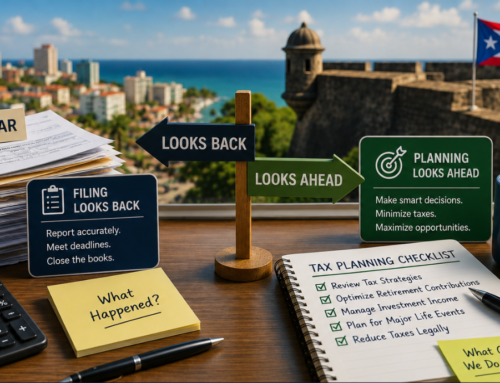
Tax filing is required. It reports income, expenses, payments, and deductions after the year has ended. Tax planning is proactive. It helps you make decisions before the year closes.
This distinction is especially important for self-employed workers because many financial decisions are connected. A tax choice can affect cash flow. A retirement contribution can affect liquidity. An insurance decision can affect risk. A business expense can affect net income.
Tax Filing Looks Backward
Filing is mostly historical. It organizes the past year into a return. That is necessary, but it may not give you much room to change the outcome once the year is over.
Tax Planning Looks Forward
Planning gives you more control. It lets you look at income, expenses, estimated payments, savings, insurance, and business decisions while there is still time to respond. For a self-employed worker in Bayamón, that can mean fewer surprises and more confidence.
How Financial Planning Helps Self-Employed Workers Reduce Guesswork
Many self-employed workers make financial decisions one at a time. They talk to a tax preparer about taxes, buy insurance separately, open an investment account somewhere else, and think about retirement only when cash is available.
The problem is that these decisions are connected. Treating them separately can create gaps.
That is where financial planning in Puerto Rico becomes valuable. It helps bring taxes, retirement, insurance, investments, business income, and personal goals into one organized view.
Why Taxes Should Not Be Reviewed Alone
A tax decision may look good by itself but create pressure somewhere else. For example, contributing too much to retirement without keeping enough cash available may weaken business reserves. Paying down debt aggressively may feel responsible, but it may leave little room for taxes or insurance. Holding too much idle cash may feel safe, but it may slow long-term wealth building.
A coordinated review helps connect these choices so they support the same financial direction instead of working against each other.
How a Coordinated Plan Creates More Confidence
A well-structured plan gives self-employed workers more clarity and confidence in their financial decisions. It helps answer practical questions: How much should I save? How much should I reserve for taxes? Should I invest or pay debt? Do I have enough protection if income stops? Am I building retirement income or only covering today’s expenses?
These questions are not just technical. They affect daily confidence.
When Should You Speak with a Financial Advisor in Bayamón?
A self-employed worker can seek guidance before tax concerns become urgent or difficult to manage. In many cases, the best time to review your plan is when income is increasing, expenses are changing, or the end of the year is approaching.
A financial advisor in Puerto Rico may be helpful when your income has changed, your estimated tax payments feel uncertain, your retirement savings are inconsistent, or your business and personal finances feel too connected.
Signs You May Need a Financial Review
You may want a financial review if:
- Your income increased or became more irregular this year
- You are unsure how much to reserve for taxes
- You have not reviewed retirement contributions
- You are mixing business and personal spending
- You earn well but still feel financially disorganized
These are not signs of failure. They are signs that your financial life may need more structure.
Read Also: Disability Insurance Planning for High-Income Professionals in Puerto Rico
Conclusion
Year-end planning gives self-employed workers in Bayamón a chance to step back, review the numbers, and make better financial decisions before tax season begins. It is the right time to look at income, estimated tax payments, deductible expenses, retirement contributions, insurance needs, and long-term goals.
The purpose is not only to prepare for taxes. The purpose is to create a stronger financial foundation.
At JLA Financial Planning, we help Puerto Rico residents review how taxes, retirement, investments, insurance, and risk management can work together in one coordinated strategy. If you are self-employed in Bayamón and want more clarity before year-end, a professional review can help you identify gaps, organize your plan, and make decisions with more confidence.